Pages

Wednesday, November 25, 2009

The Cracked Kettle


My first night in Amsterdam, I went to this great beer place called In de Wildeman.

It goes without saying that they had numerous excellent Dutch and Belgian beers on tap, but I was astonished to find a few American style ales on tap as well. This was a welcome surprise for me. I knew that my travels around Europe would take me to plenty of rich spirited Belgian lambics, Czech pilsners, and German weizenbocks, but I hadn't expected to see the pungent ales that I'm accustomed to having back home. I was excited by the idea that I wouldn't have to be giving up some of my favorite styled ales while I traveled around Europe.

The next day as I was biking around the canals, listening to my ipod, I passed by a window that made me come to a full stop, almost falling off my bike. Here's what I saw:

Rogue??!! In Amsterdam??! This was really too much; I had to go in. It was in this way that I discovered Amsterdam's finest spot for purchasing beer: The Cracked Kettle. Owner Jeff Cunningham is actually an American, from Boston, and he's done a great job stocking his store with a wide array of European and American beers– something for every palate.

Unfortunately, I forgot to write down all the different American beers he was stocking, but I do remember seeing Rogue, Stone, Port Brewing, Lost Abbey, Three Floyds, Russian River, Dogfish Head, Victory, Allagash, Alaskan, and Bells.

Aside from the beer selection the store just has a really amazing feel to it. Beer and wine cover every square inch of its two floors. Shelves are so stocked with beer that bottles literally hang half off. The cases extend from floor to ceiling so that you have to be careful not to kick over bottles and have to get a ladder to reach the highest shelves. The wood interior also gives it a feel more like being in someone's beer cellar or old fashioned library than beer store.

After discussing a few of the west coast smaller companies and newest brews that Jeff wasn't familiar with, he introduced me to some of the most cutting edge Dutch brewers, who are taking our American craft style to new highs.

Brouwerij de Moulen are a Dutch brewery doing some amazing work. I only tried their darker heavier beers, but it looked like they had a number of excellent varieties.


I had this Bloed, Zweet, Tranen, which was a lot like a smoked porter. I'll put up some tasting notes on it in a separate post.

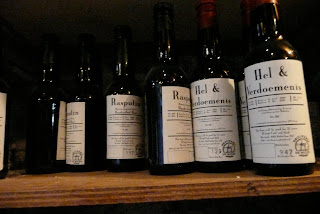
They have some limited runs that have these beautiful labels that look like they were printed in the 1800's.

Of particular note from this series was a beer liqueur that they created, shown here. Yes, a beer liqueur!

I tried the Rasputin, not be confused with the Rasputin that North Coast Brewing makes. Strangely enough though, this was also a Russian Imperial Stout (I mean, the name is Rasputin) that I really liked.

The one I sampled was from a batch of only 960. It was really smooth without losing anything in richness or boldness. I don't think I've ever come across a Russian Imperial with such a perfect balance of chocolate, and yet it had just enough bite to add complexity and flavor to it.

Another recommendation was Brouwerij De Prael, based out of Amsterdam. Unfortunately, I didn't get to taste any of these so I can't say too much more about them.


Also of note was Nogne O, actually a Norwegian brewery doing some excellent beers that I've seen available in the US.

Last, but certainly not least, is the Mikkeler label. Jeff told me that unique thing about Mikkeler is that it's actually just one guy, who I believe is Norwegian. He refers to himself as a gypsy brewer because he goes around to different breweries in Europe (mostly in the Netherlands) and the US and rents the space from them to brew different batches.

After checking out his site, I was pretty amazed at how many brews he's been able to put out using this method. I was lucky enough to try the Simcoe Single Hop IPA , the Black Hole (a rip roaring Imperial Stout), and the Struise Mikkeller (a sort of IPA belgian hybrid).

I was seriously impressed by the stuff that Mikkeller is doing and from the beers that I tasted and saw, it seems like we enjoy the same beers. So of course, I was overjoyed when I went to Beverage Warehouse last week and found that they were able to bring over a few Mikkellers.

After spending some time browsing through the store and talking with Jeff, I packed up a few of these bottles and set off on my bike around Amsterdam eager to try more. Next time you're in Amsterdam, definitely stop by this shop!

Wednesday, November 18, 2009

My top 5 American IPAs

First of all, for those that have asked, pictures from Europe are coming, including a special feature on an amazing beer store I found in Amsterdam. I've had some trouble with my SD card, but I should be getting the photos up soon.

Based on the emails I received about the last top five beers entry, I decided to do another. American IPAs are far and away my favorite type of beer, and there are a number of incredible brewery's out there making great versions of it.

Here is the definition of an American IPA from Beer Advocate: "The American IPA is a different soul from the reincarnated IPA style. More flavorful than the withering English IPA, color can range from very pale golden to reddish amber. Hops are typically American with a big herbal and / or citric character, bitterness is high as well. Moderate to medium bodied with a balancing malt backbone."

Most people are always intrigued to hear about the origins of this particular beer. Here's what my minimal research has told me.

IPA descends from the earliest pale ales of the 17th century. The term "pale ale" originally denoted an ale which had been brewed from pale malt, most beers before then were much darker and murkier. The October beer of George Hodgson's Bow Brewery was the world's first India Pale Ale. Bow Brewery beers became popular among East India Company traders in the late 18th century because of the brewery's location and Hodgson's liberal credit line of 18 months. East Indiamen transported a number of Hodgson's beers to India, among them his October beer, which benefited exceptionally from conditions of the voyage and was apparently highly regarded among consumers in India.

Demand for the export style of pale ale, which had become known as "India Pale Ale," developed in England around 1840 and India Pale Ale became a popular product in England. American, Australian and Canadian brewers manufactured beer with the label IPA before 1900, and records suggest that these beers were similar to English IPA of the era.

According to Wikipedia, stories that the additional hops used in order to help preserve the beer on the long trip to British Soldiers in India are false. While I do agree that it seems entirely possible for other beers besides an IPA to have made a four month trip to the subcontinent, I have to imagine that the IPA style was highly influenced from this trading/military route. A couple of facts to consider are 1. Hops are a natural preservative, 2. Alcohol is also a natural preservative and these beers had higher alcohol content, and 3. The long journey would allow for extra ferment time, making for a stronger and hoppier beer, especially if they were employing methods like dry hopping, which Hodgson was known to do.

Within the USA, there is a distinct type of IPA called the "West Coast IPA," which goes for a much more bitter, hoppy character than other IPAs, although the east coast brewed as many so called "West Coast" IPAs. The hops in West Coast IPAs tend to have a citrus, grapefruit or coriander flavor, as opposed to the wood and pine accents of some IPAs brewed on the United States' east coast.

And now, my favorites:

Russian River Blind Pig - It's hard for Russian River to do any wrong in my eyes. They brew big fresh hop and big tasting beers that are really unlike anyone else. The Blind Pig is no exception, and you can taste the freshness of the dry hopping.

Anderson Valley Hop Ottin IPA - For many years, this was my favorite IPA. It's incredibly well balanced and worth trying if you haven't already. Recently, I've noticed the beer hasn't been holding up as well, and I can't be sure whether that's due to a change on Anderson Valley's part or my tastes.

Bear Republic Racer 5 - Thank God for Racer 5. Seriously. In the past few years they've managed to get much better distribution and can be found in most bars around the SoCal area. It's a really well crafted beer, with enough hops for the bitter inclined and enough balance for non-hops lovers.

Port Brewing High Tide IPA - Probably my hands down favorite of all the IPAs on this list. It's a seasonal and can be very hard to find, but should become available sometime this winter. It's a beautiful ode to Simcoe hops and the citrus freshness is unparalleled.

Rogue Independence Hop Ale - Technically, Rogue classifies this as a Fresh Hop Pale Ale. But to me that has IPA written all over it. Hop lovers can rejoice with this one.

Others worth an honorable mention are Lagunitas IPA, Avery IPA, Victory Brewing Hop Devil, Deschutes Hop Trip, Alesmith IPA, Port Brewing Wipeout IPA, and Stone IPA.

Tuesday, November 17, 2009

The Resistance double IPA


Having gotten a handle on my beer making skills after my last IPA, I wanted to try to make something really big. So began my Double Trouble IPA, The Resistance. I wanted to make a beer that had high alcohol content, but still really bright floral and citrusy hoppy notes. In order to achieve this I tried my first dry hop. For those unfamiliar with the process, dry hopping involves adding hops to the beer after the initial fermentation. It helps to get that fresh hop taste I was looking for.


.5 lb English Crystal 37L
.5 lb English Crystal 17L
6 lbs Pale malt extract
3 lbs Munich malt extract
1 lb Light DME
I did a 1 oz Summit addition at 60 min
1 oz Summit addition at 30
1 oz Summit addition at 20
1 oz Amarillo addition at 0


I let my primary fermentation go about a week, then my second fermentation was around 3 weeks before I started dry hopping. I used 1 oz Simcoe whole hops to dry hop. Whole hops I now know are really hard to dry hop with because both putting them in the carboy and filtering out the pieces is a problem. But live and learn. I let the beer dry hop for about 4 weeks and then finally aged in the bottle for another three weeks.


All and all, I achieved what I was going for in term of hop taste. The beer is very bright and you can really taste the dry hopping. However, I didn't get the vigorous ferment I was hoping for and alcohol content is only around 5-6%. I also feel like it could use a little more malt sweetness to round out and balance the flavor a bit.


Monday, October 19, 2009

David vs. Goliath

This is pretty frustrating, not only as a beer drinker, but simply as someone who believes in free enterprise and is tired of corporate America.

Thursday, September 10, 2009

My favorite double IPAs

Trying something a little new here, I'm going to put up some lists of my favorite beers according to type. This week, I'm listing out my top five double IPAs.

For those of you who are not familiar, this is how BeerAdvocate defines a double IPA,

"Take an India Pale Ale and feed it steroids, ergo the term Double IPA. Although open to the same interpretation as its sister styles, you should expect something robust, malty, alcoholic and with a hop profile that might rip your tongue out. The Imperial usage comes from Russian Imperial stout, a style of strong stout originally brewed in England for the Russian Imperial Court of the late 1700s; though Double IPA is often the preferred name."

While they often tend to be fairly high in alcohol content, I think they're well worth the journey for the wonderful taste and heightened revelry. Here are my picks:

Rogue I2PA - This is a fantastic beer because of its incredible hop profile, yet wonderful balance. I just recently had this at the Rogue Public House in San Francisco and it still holds true as one of the best.

Pliny the Elder - Russian River loves dry hopping and Simcoe hops, and they really come through in this masterpiece. It's really bright, grapefruit citrusy, with a little bit of skunk. Very light bodied, but still quite strong. You can often find this beer available at Father's Office.

Avery Maharaja
- I wrote a review for this a few months back, and then was lucky enough to find it on tap at the Daily Pint. Rich, tangy, and with apple tones, this is not the usual kind of double IPA I would pick, but it's a fantastic one.

Stone Ruination IPA
- I'm a bit torn about putting the ruination on here. Recently, Stone has been releasing beers like their 13th and the Black IPA that just on another level from their original stable of beers. But the Ruination, was probably the first double IPA I ever tried that really taught me what a double IPA could be, and it is still one of the best.

Anderson Valley 20th Anniversary Imperial IPA
- I reviewed this beer a few months back. It's probably not quite as well balanced as some of these others, but it certainly holds up in flavor.

Monday, September 7, 2009

Avery Sixteen Saison


Most people who check in with my blog from time to time know, I don't usually take much time out for tasting Belgian styles. But I'd been so impressed with Avery recently that I thought I'd give this a try. This is Avery's Sixteenth Anniversay Ale and as it advertises on the bottle it is light, flavored with jasmine, peache, and miel. A decent head with an extremely dry, light body, I'm not particularly attracted to the aroma, which is that characteristically Belgian spoiled fruit smell. I'm not sure how to put into words the taste that the Belgian yeast creates, but I can always recognize it when I have it. It's combination of arousing clarity within the malts and crispness in the flavor. Sweet mellow aftertones like summer jazz in a European outdoor park are what you're left with. Certainly light and flavorful, but just not my hop crazy pallette's cup of tea.


Sixteen Saison: **1/2

Friday, September 4, 2009

Blog Requests

I was talking to my brother about the blog and he was suggesting that I do a few posts about beer types and beer purchasing for a more practical approach to trying beers, e.g. where to buy the best beer on tap or in the bottle, what kinds of things to order and where, the best beers to get at Trader Joe's, etc. If you have a suggestion for a discussion topic or have something you'd like to know, email me or make a comment.