Pages

Tuesday, February 22, 2011

Tony P's and Oskar Blues Beer Dinner

For the past few months, Tony P's has been hosting a beer pairing dinner once a month.  Last week, I had the opportunity to join them for their Oskar Blues night.  In full disclosure as a blogger, I was invited and paid for to attend, but I think my observations are still pretty impartial.  Here's a little recap.
I wasn't too familiar with Tony P's.  In my mind, I pictured it more as a Gator dominated sports bar than a beer bar.  However, I was quite surprised when I arrived here to find out that they have 40 beers on draft and 60 to 70 different choices of bottled beers. Of those 40, 30 are resident and 10 are rotating.  Obviously, with their beautiful brand new LED flat screens they're catering more to the interested beer and sports fan then uber craft beer nerds.  But that being said, I was able to find several beers on their menu that I hadn't tried, which is saying something indeed.

The first pairing was Dale's Pale Ale with a chicken cordon blue calzone.  Dale's is a pretty good and standard pale ale.  I find it's body to be slightly metallic and thin, but it's got a very nice hop finish and a very even malt front end.  Here's Kat and Naheed cheers-ing with a Dale's.
... And MJ cheers-ing to camera with a Dale's
The calzone came stuffed with chicken and spinach with an alfredo sauce poured over the top of the whole thing.  The pairing was really quite enjoyable; the carbonation and light body of the beer cut nicely through the heavy alfredo sauce.

Next up was the Gordon, which is a blend between an Imperial Red and a Double IPA.  I've never really heard of anyone doing this before and I'm not really even sure what it means.  I'm not sure why that hybrid isn't just... an Imperial Red? At least that's what I imagined the flavors would be.  But I think the key point here is that it's a blend, not a hybrid, so I'm imagining they mixed the two beers post brew, rather than during the boil.

This was served with a Spicy Mac-N-Cheese, which has chorizo and roasted pasilla peppers.  This was probably my favorite pairing of the night.  
While the Gordon was good on first taste, it wasn't blowing my socks off.  I tasted raisins with a touch of caramel and I thought it actually tasted a lot closer to the Old Chub with a little hop finish at the end.  It did have a good body though.  However, the spiciness of the chorizo complemented the beer perfectly.  It made the hop finish really pop.  The Gordon has just enough body to stand up to the much bigger hop rush that's brought out from the spice.  This was really nice!Course number three started with the Gubna Double IPA.  Gubna is a great double.  What's most impressive is they created the beer using only Summit hops.  Summit is high alpha stuff and leaves a wondeful piney, citrusy aroma with a great bright hop finish.  Brewed with Dark Munich grains, it still maintains its balance and light color for a double.  
This was served with a smoked pork mole, which was quite good, and very spicy. Unfortunately, the two didn't work as well together as I would have hoped.  While spices are usually good with hoppy beers, the mole was so heavy that it killed a lot of the beautiful Summit flavor in the beer.  Otherwise though this was pretty enjoyable.

Next up was the Old Chub, their Scotch Ale.  Tony (of Tony P's), proclaimed this beer as his favorite, and he may be on to something.  I've been seeing Old Chub popping up more and more and I think this beer may be a big winner in the end for Oskar Blues.  It's currently rated as the top Scotch Ale on Beer Advocate and it has the potential to gain a lot of popularity due to its appeal to both novice and experienced Scotch Ale drinkers.  For those who aren't familiar with Scotch Ales, they undergo long boiling periods in order to caramelize the wort.  This creates a fairly potent and sweet with a full mouth of roasted grains in a full-bodied mix.
Unfortunately, due to these characteristics, it's a hard beer to pair with.  In this case, it was paired with a Catfish Po Boy, with collared greens and ham hock on the side.  I'm not really a big catfish fan, nor did I have much room left in my stomach after 3 prior courses, so I didn't have too much of this one.  My impression on the pairing though was that it wasn't bad, but the dish and the beer didn't do too much for each other.
For dessert we had Ten Fidy, their Imperial Stout with a Chocolate Brownie tart and vanilla ice cream.  Ten Fidy was fantastic as always, but it simply couldn't hold up to the level of sweetness in the tart.  Still, I enjoyed eating and drinking both.  
Here's MJ drinking his Ten Fidy, acting like he's too cool for school... actually he is, I've seen his high school book reports.
I have to hand it to Tony, he gave us pretty sizable portions of beer and food all night; this wasn't a little tasting session.  Afterwards, I spoke with him and he's really trying to get people to drink better beer.  He's got an amazing setting to do it in with a secluded dining room and sports bar in the same building, he's on his way to getting people to drink better beer.

Tony P's will continue to hold beer pairing dinners once a month.  Next month he's doing a special Irish themed meal with several beers from the UK.

Tuesday, February 15, 2011

Port Brewing Midnight Sessions


In case you haven't read my blog before, or in a while, let me just say: I love Port Brewing.  I love the names, the beer, the attitude, and I love that they started with a pizza and beer place.  In honor of opening this Midnight Sessions, which has been sitting in my fridge for quite a while, I've ordered a pizza from Dagwoods to go with; half Woody's, half Greek, should be delicious. 
For those that may not have read my posts about Black Lagers before, here's a little review.  The Black Lager is basicaly an American take on the German "Schwarzbier."  Schwarzbier sounds like something they might have drank in Spaceballs and while I won't rule that out, Shwarzbier literally just means "black beer."  It's a fairly simple description for what actually is a fairly complex lager.  A good Schwarzbier is going to be a dark brown, bordering on black, yet should still have a very light body; being a lager helps with that.  The goal is to drive out all the fruit flavors and have nothing other than roasted malt flavor and a bit of hops. 

The aromas have a distinct roasted malt flavor.  It's a deep smell with hints of salty sea air and a dry body.  The head lacks a tremendous amount of retention, but it's a good amount for the pour.  The color is extremely dark, bordering on black.  It's only when you hold it to the light that you can catch the subtle amber and brown tones.  The first part of your sip is a load of carbonation with a distinct taste of bitters.  As it opens up it becomes a concentrated blend of roasted grains and coffee, but is supported the whole way by that thin undercurrent of bitterness.  Oh hell yes, the pizza is here, looks amazing.  Here you go, you get to share the experience a bit. 


So back to the beer.  Hints of chocolate in the grains, a beautiful mix with the coffee, but a totally different experience than a coffee stout because of the light body.  As it finishes, the coffee and hops take over leaving a lovely rich bitterness on your tongue.  My only complaint on this beer is that its mouthfeel is so carbonated that it borders on soda like quality.  But otherwise it's a solid black lager.  The coffee addition is brilliant and mixes perfectly with the choice of hops and roasted grains.  Nicely done Port!


Midnight Sessions: ****1/2

Tuesday, February 8, 2011

Founder's Breakfast Stout


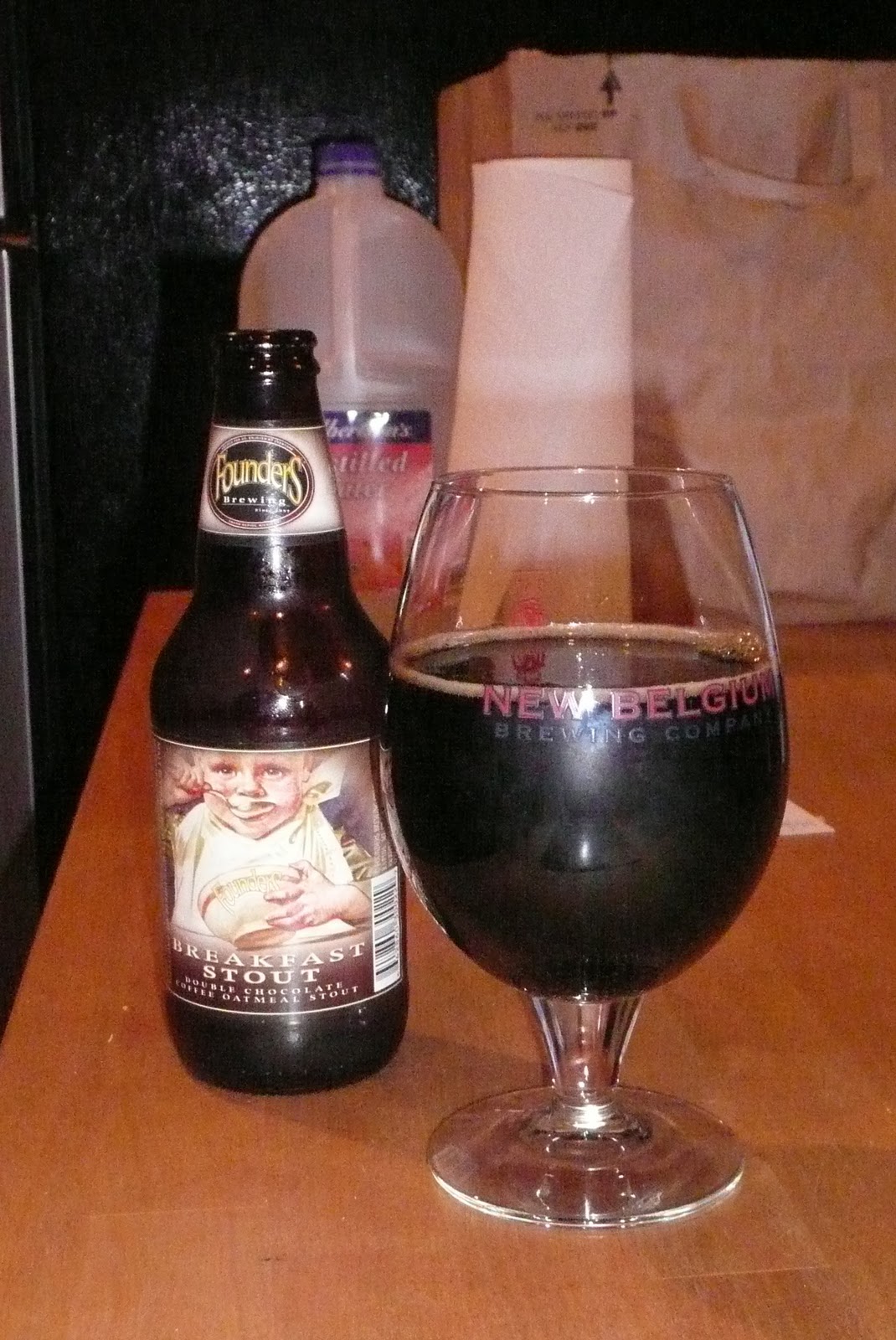
While this is a breakfast stout, I'm not having it for breakfast.  In fact I'm having it after a long day at work and a dinner long since digested.  This is the irony of coffee Stouts.  While their coffee flavors would suggest a morning beverage, the rich chocolate malts also make for wonderful after dinner drinks.  I've heard about Founders quite a bit in reading magazines and through the "hop-vine," however, I hadn't found them in many places in Southern California.  I was able to pick up this bottle on ebay for a hefty price though.  You'll notice these pictures were taken at the new place.


This pitch black beverage has zero head and looks completely opaque, although when held to the light you can detect the slightest hint of ruby brown.  Aromas are of rich chocolate, strong coffee, and hearty alcohol.  The flavor is simply put, a mouthful of coffee.  They've enriched this beer with both Kona and Sumatra coffees, which is really coffee heaven if you're someone who likes coffee.  The effort they went to for these beans certainly pays off, as the flavor is distinct, rich and bitter.  I've had quite a few Coffee Stouts, but this has got to be by far the strongest coffee flavor I've had in any of them; perhaps almost too a fault.  While the flavor and tone of the coffee is delicious, it's hard for the chocolate and oat flake flavors to distinguish themselves.  Towards the end of the sip, the coffee begins to thin out and leave a slight metallic sort of ringing on the palate. 

As I have a few more sips, I'm able to pull out some of the chocolate and flavors of roasted grain and jut the slightest hint of oats, but it's serious work to distinguish them from the coffee.  Now I love coffee, so you won't have many complaints from me about this.  However, part of what I like about this breed of beer is it's ability to mix coffee in with the other flavors.  So while the taste distibution is somewhat limited, it's hardly a fault I can hold against it.


Breakfast Stout: ****

Tuesday, February 1, 2011

Santa Cruz Aleworks, California IPA


Wow, there's a surprise for you.  This beer poured almost all foam, much to my disappointment, as you can see in these photos.


Sort of ridiculous, I don't know whether I accidentally hit the bottle on it's way out or if it was just bottled under extreme pressure.  Took about five minutes to get this to calm down.

The aroma is surprisingly far more floral more reminiscent of Belgian styles than the piney hops I was expecting.  There's a little bit of fruit in there, but far more orange pulp than lemon or grapefruit rind since I'm getting sweet aromas.  The color is an orange bordering on golden, but it is a little cloudy which gives it a deeper hue.


The flavors in this beer are a little disappointing.  Maybe I was expecting an American IPA based on the bottle description, but this is clearly a Belgian IPA by the use of grain, yeast, and hops.  Flavors are very sweet up front with loads of carbonation.  This really gets too sweet for me and I'm reminded of a carbonated fruit juice.  Otherwise there isn't much at all up front, what few flavors there are feel muffled, or perhaps drowned, in an excess of water.  The taste does an about face towards the middle of the sip moving rather abruptly for the hop finish; too soon I'd say, as the fruity front end really dissipates into a highly watery mixture that doesn't do a good enough job of bolstering up the hops.  The hop finish is strong, but very lopsided since it feels like a thin layer of industrial styled bitterness offering very little in accompanying flavors.

Ultimately, this is far more of a Belgian IPA than an American one, and almost borders on a Saison.  But even after reclassification it doesn't do much for me since the malts don't impress any paticular urgency in their identity.  Somewhat surprising that a Santa Cruz beermaker would choose to go in this direction; with a name like California IPA, I'd expect American IPA flavors. Apologies to the makers, but I just didn't like this one.


California IPA: *1/2

Tuesday, January 25, 2011

Nogne O Imperial Dunkel Wit

This strange creation from Nogne O (a name I still can't pronounce) is meant to be a pleaser for everyone:  people who like Belgians, people who like dark ales, and folks who like big beers.

There's very little head and even less retention on this beer, which strangely has the color of root beer.  Aromas bring to mind plums and raisins, but only slightly as there isn't much aromas coming off this.

My first sip brings quite a bit of confusion, but plently of enjoyment.  The best way to describe it might be a beer of many movements because it seems to have distinct flavors of taste in multiple waves rather than one building arc.  Hops strike first combined with a concentrated burst of carbonation that directs right to the front of your tongue.  There's hints of purple grape underneath the bubbles.  From there the beer expands out to the rest of your pallette bringing a strange mix of fruity esters, roasted grain, and acids.

There's a little bit of an orange tang to the medium-heavy body, which makes sense since they use orange peels in the brewing process.  That orange mixes nicely with the slightly plum flavored alcohol taste that creates quite a bit of heat on the tongue.  The alcohol and fruit build to a nice finish on their own and are quickly followed by an additional finish, which is a mixture of roasted barley and hops.  Once again, this finish is good in its own right, but seems so distinct from the one you just enjoyed only micro seconds before.  Finally, the real finale kicks in with moderate a hop attack at the back ends of your tongue.

Unfortunately, all three finishes do not combine to any sort of building orgasmic symphonic arrangement, instead remaining relatively distinct, like three musicians unaware that they are all playing in the same practice room.  The only thing that connects these three movements is the hot taste of alcohol running through the palate. This warm streak, mixed with the decently heavy body makes the beer seem a little boozy.

The beer has excellent qualities and some great flavors, however, the packaging could use some work as those flavors are delivered intelligently but perhaps not as delicately as needed.  It's probably most similar to a Belgian Dark/Strong despite the description because the fruity esters are certainly the most overwhelming flavor; a similar beer would be Trois Pistoles.  All that being said, it's doing the trick for me tonight, and while it's drinkability might be considered to be on the lesser side of average, I'd still say it's worth a try if you can find it.


Imperial Dunkel Wit: ***

Tuesday, January 18, 2011

In Defense of Hops part 2

This week I'm responding to Lizzie Buchen's response to my response on her article from last week.  Her original response is at the end of this post.

Hi Lizzie, first of all, thanks so much for taking the time to read my blog and write such a coherent response.

I'm glad to hear you like hoppy beers and I hope no offense was taken by my response. I realize your article was much more about the science and origins of our (in)tolerance for bitterness and I thought your research was very interesting.

From a beer drinker and brewer's perspective, it triggered a familiar though slightly tangential complaint I hear a lot about hops.  Whether it's novice drinkers or beer traditionalists, they all seem to have something negative to say about the over hopping trend.  I have a fairly defensive attitude towards these folks, not only because I love these beers, but because I believe American hops have had a transformative effect on the creativity that has defined and caused a resurgence of American beer.  So I'm glad to hear that you actually like hoppy beers and that's a lovely reference you make to the relative newcomer Ninkasi.  But for the purposes of furthering general discussion between the unlikely candidates of a beer blogger and a science writer, here's a few things I wondered about.

Your question whether I would drink Pliny if it didn't have any alcohol is a great one.  It goes without saying that removing alcohol from the beer would alter the balance of flavors and the consistency of the beer.  You would end up with a liquid that bears little resemblance to Pliny at all (I shudder at the thought).  So yeah, chances are I wouldn't want to drink that strange brew.

But I assume you mean in the hypothetical that the flavor was unaltered and it magically had no alcohol content?  Well sure, why not? I'd be drinking Pliny right? The same taste I've grown to know and love?  The fact that I'm not getting drunk isn't really a big issue if the flavors are the same, it's the taste that I think is amazing. I probably wouldn't drink it in the same locale and chances are they wouldn't have it at my favorite bar. When I order a beer, high or low alcohol content, I'm thinking about what flavors I would enjoy, what styles I like, not how drunk it will get me.  If I was concerned primarily with sobriety, why spend all this extra money on beers for my beer fridge and travel to far off specialty beer bars?  I could just sit at home with a 40 oz of Steel Reserve.  Now that being said, the associated effects of alcohol are certainly welcome participants in the drinking process, but it's always flavor first.

Take a real world example of this point with something like Yerba Mate.  It has an incredibly bitter taste with no alcohol content and yet is enjoyed all over South America and now in certain areas of the Middle East.  Here's an extremely bitter drink that has become quite infused with Argentinean culture.  Now you could make a similar argument replacing alcohol with its stimulative effects.  But I think heavy Mate drinkers would say something similar.  Perhaps the stimulative qualities are why they tried it for the first time, but the taste they have grown to love.

I'd be interested to know if there has been research done in similar areas regarding other cultures' where bitter foods are more prevalent.  Food items like arugula, raddichio, bitter melon, dark chocolate, just to name a few.  I don't know the research, but I wonder what prompted their infusion into the cultural cuisine?

Lastly, I like to remind people that America's brewing roots are as much Germanic as they are British and up until the advent of mass market beer, we actually had a rich and vibrant beer culture here in the US, complete with our own Oktoberfest.  Of course the hop varieties back then were nothing like the super alpha strains we have now, but when we talk about acquiring a taste for hops, it's important to remember that we're actually re-acquiring those tastes.

Regarding Toronado's fullness factor, I absolutely agree: people generally don't like to hang out in empty bars drinking by themselves... unless maybe it's a pub in Lancashire.  However, to reduce the popularity of said bar, or any of my favorite beer bars really, to a crowded room, might be an oversimplification.

First of all, there's clientele and atmosphere.  It's not just that it's crowded when I go to a beer bar, it's crowded with people that generally I'm more interested in.  We both made the choice to come to this establishment for better beer than they're serving down the street.  I respect that choice.  There's also whatever the purveyor puts into the place that maybe can't be conveyed with simple descriptions.  Creating a space where people can happily socialize isn't easy, just ask the hundreds of restaurant and bar owners that close up shop every year.

However, diving into the social psychology of what makes people choose particular bars might be opening up too large a can of worms to tackle and I certainly feel like I'm at the limit of my expertise.  So let me return to a factor that I know more about and is not to be overlooked: selection.  I'd argue that the number one factor behind a bar like Toronado's success is the amount of taps and the fantastic selection in their choices of what to pour.

Having this kind of selection not only requires having  knowledge of and access to these beers, but having enough space in which to keep them fresh, which is no easy task.  If Toronado was known to serve funky beer, undoubtedly their attendance would suffer.  At least among beer geeks like me it would.

Thanks again for writing, reading, writing again, and reading again.  It's great to have these kinds of dialogues.

Cheers! (Written while drinking a Mikkeller Tomahawk Single Hop IPA, very grassy, a bit too earthy with a nice bright finish)

Original comment from Lizzie Buchen:

Hi, thanks for posting about my article. I was inspired to write this article because I absolutely love hoppy beers -- but I know that wasn't always the case. I certainly remember when Sierra Nevada Pale was the hoppiest and most bitter beer I could handle. But then I started drinking other IPAs (Racer 5, Lagunitas), and suddenly, I found Sierra Nevada somewhat boring. And the trend continued -- I started drinking Pliny, Torpedo, Tricerahops etc., and suddenly, even Lagunitas had lost its bite.

This fascinated me. Bitterness is a sensation that we evolved to dislike because it often indicates poison. Yet I found myself craving increasing levels of it. (I know hoppiness isn't all about bitter--I love the aroma as well--but it's the overwhelming sensation). I started wondering -- are my taste buds adapting? Are my expectations changing? I even spent a while looking into whether Sierra Nevada had changed its recipe to decrease the hops! And the most interesting aspect is I'm not just "getting used to" the hoppiness; rather, I actually *like* it. How would humans evolve to enjoy something they're supposed to spit out?

I list a number of theories in the article. I certainly never connected drinkers of craft beer to addicts of any sort, but I do think alcohol plays a role. (The link to caffeine was that perhaps it helps people come to like the bitterness in coffee. I assume you drew the marijuana link from my reference to its aroma, which I think is quite pleasant, even though I'm not addicted to marijuana). Would you drink a non-alcoholic beverage that smelled, looked, felt and tasted exactly like the true Pliny the Elder? I certainly wouldn't.

As for the wealth/popularity/wealth view, I think this is a really interesting area of consumer psychology. A number of tests have shown that humans are influenced by price tags, such as the psych experiment I referenced where people judged "$90" wine as better than "$10" wine, even though, in reality, they were the same exact wine.

As for popularity -- don't you think one reason The Toronado is always so crowded is that, well, because it's always so crowded? People like being with other people, and sharing in the same activities as their neighbors. People try new beers all the time at the recommendation of friends. If they don't love it the first time, they might keep drinking it because they trust their friends' judgement. It doesn't mean they're "followers". It's another interesting part of our evolutionary history -- we are social animals.

And then, of course, there is the taste and the aroma, which people genuinely come to enjoy. Perhaps we get used to the bitterness, and come to appreciate these lovely, subtle notes.

These are all theories, and I'm not saying they all apply to everyone in every situation. But I think some of them apply most of the time. They were all fascinating for me to learn about, so I thought my readers would be interested to learn about them too. I hope so!

Cheers!
January 17, 2011 2:54 PM

Tuesday, January 11, 2011

In Defense of Hops


Recently, a friend sent me this article from the New Scientist.  My apologies that this isn't an open link, however, the registration is free and the article is fairly short if you'd like to read it.  If you'd rather not, it's called, Extreme Beer: No Accounting for Taste, and I'll summarize by giving you the tag line: "American craft beers are getting ever more bitter, expensive and undrinkable – so how do we learn to savour tastes we're hard-wired to spit out?"  The article goes on to make a few observations about the surge in craft beer popularity and then tries to suggest some possible evolutionary reasons behind our predilection for odd tastes, namely bitterness.  The article also spends some time talking about Russian River's Pliny the Younger, which needs no explanation or introduction for my audience, except to say that it seems to have reached a new level of recognition even beyond the confines of the craft beer world.

It's interesting science, although the conclusions seem to be incredibly negative, painting the motivation behind craft beer drinkers as drunken, caffeine and marijuana addicts, looking to prove our wealth, popularity, and masculinity, from an evolutionary standpoint that is.  It's a portrait that might have some truth as you gaze across American culture, but probably less so in the craft beer market as compared to the mass beer market.  


But accurate or not, something bothered me about this article as I read it.  I actually was just drinking Pliny the Elder (Younger's lesser, but much more attainable cousin) and Russian River's Temptation '08 (one of the famous sours she refers to in the article) last week at Toronado in San Francisco.  The place was packed, the beer was delicious, and it was a great time.  Surely this Thursday afternoon could be attributed to far more than the evolutionary outcomes of a bar full of people's misguided desires and addictions. 

From a beer drinker's perspective, whether a hops lover or not, I think there is a foundation in history that has informed culture and is worth mentioning.  Surely, when someone thinks of the unpalatable flavors in beer, the first flavor in question is bitterness.  And true to form, this article spends much of its time questioning (although I'm tempted to say "bemoaning") the bitterness flavor that most craft beer drinkers have become accustomed to drinking.


It's an understandable critique.  The first time I tried an extremely hoppy beer, I wasn't charmed immediately.  It took a few drinks and some exposure of the subtle flavors it contained and accompanied the bitterness, the way the alpha acids worked with the flavor of the grain and yeast to really understand how good the taste could be.  I know a number of beer snobs who think the overabundance of hops in beer is a real tragedy, and ever since hops were outlined as a required ingredient by the German Reinheitsgebot in 1516, they've been a pivotal, yet sometimes controversial part of the beer process.


Hops are a vine flower that share a lot of similarity to grapes used for making wine.  And just like grapes, they are subject to a concept called "terroir."  Terroir is the idea that the geographic climate, soil, and atmosphere impart specific characteristics to the plant.  So while Germany, the world's largest hop producer, and the US, the world's second largest hop producer, have similar conditions for growing, say a Noble hop variety, there will be subtle taste differences in the hop pertaining to the region in question.  Magnify this effect over centuries, add modern technology and a knowledge of genetic breeding in plants and we get quite a wide variety of Alpha and Super Alpha hop strains produced in the US and specific to its soil.  Names like Willamette, Chinook, Simcoe, Summit, and Cascade, just to name a few.  It doesn't take long for people to start using these hops in experimental brewing and suddenly we give birth to the distinctive flavor of the American Ale.  The American Pale, the American IPA, the American Red, and really almost every beer from the British style, all with a new bite and finish because of the hop production based locally here.


The hops arms race, started around 20 or so years ago, and saw its biggest rise in the past 10 years, as different brewers pitted against each other, trying to cram all these new super high acid hop strains into their beers.  I'm not really sure it's over, but it's a period marked by strong experimentation and individual creativity among craft beer brewers.  Now how can that be a bad thing?  In fact, I would extend that argument to say that it was this opportunity to step outside the conventional stylistic guidelines and restrictions with hops that opened up the idea of using different ingredients, experimenting with styles as a whole.


Some embrace the hop explosion and ridiculous levels of IBUs in these new beers.  Others see it as a gimmick that ruins the natural flavors of traditional beer.  Whether you're a hops fan or not, you have to admit the important role hops played in shaping the beer renaissance that followed.  That renaissance is a reflection of the real heart of American ingenuity and agriculture.  Beer, is not simply a beverage, it is a cultural reflection.  For centuries, beer has been defined by Belgian Monasteries, German Beer halls, British Pub Beers, and Czech Pilsners.  Finally, American beer has a way to separate itself from these giants with something other than mass produced flavorless lagers in cans.  Whether you like hops or not, it's important to understand that they opened the floodgates of an American revolution in beer.


So maybe the next time you pick up a pint of whatever you happen to be drinking, hoppy or not, show a little love to the bitter coned flower that helped pave the way for so many other brews.


Cheers!